Which Dimmer Switch Works with LED Downlights? Leading-Edge vs Trailing-Edge
By Admin | 11/4/2026
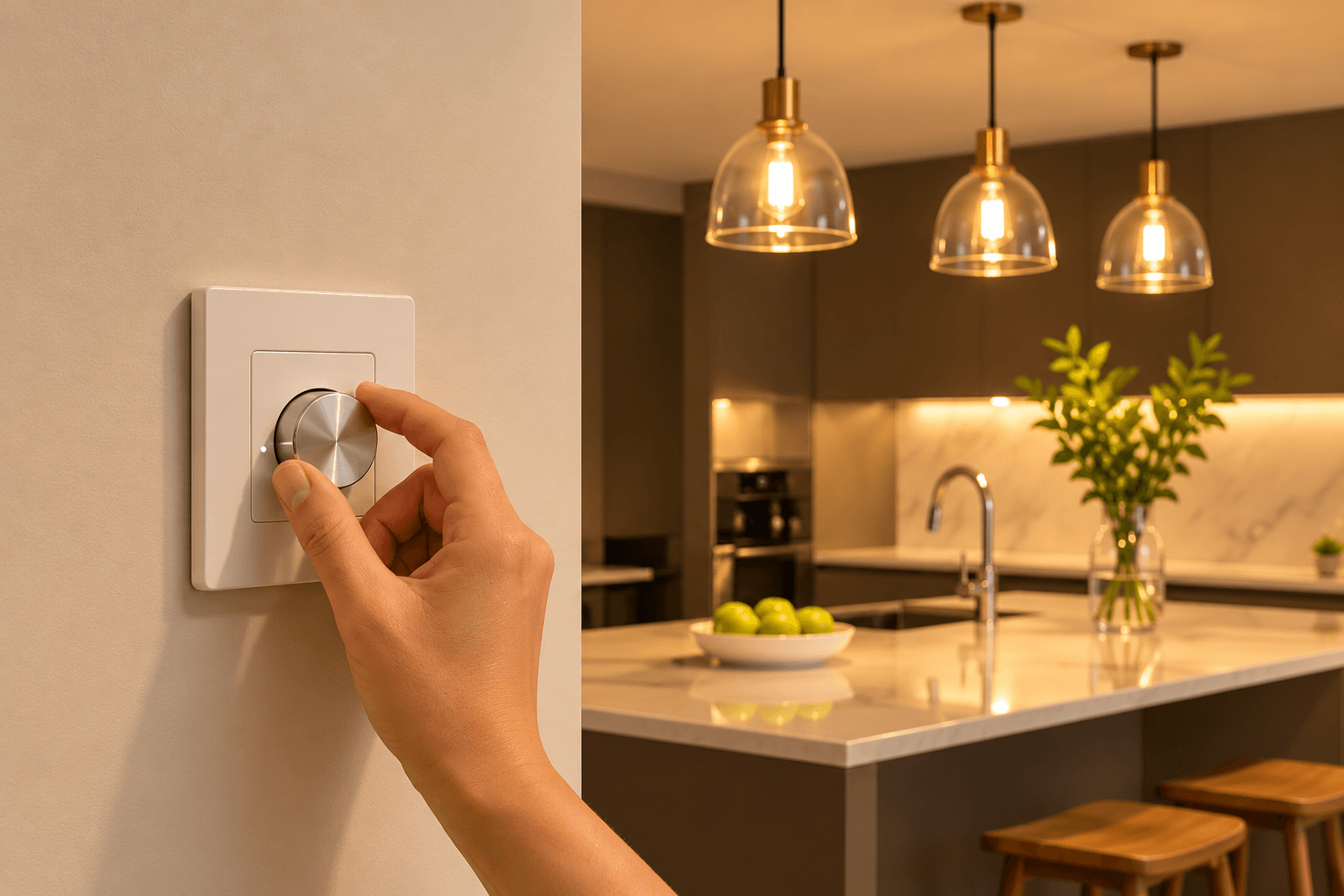
You fitted new lights, connected the old dimmer, and now they flicker, hum, or refuse to dim smoothly. The problem is rarely the bulb. It is almost always a mismatch between the dimmer and the driver inside your dimmable LED downlights. At Axion Light, this is one of the most common questions we get from homeowners, interior designers and electricians across Pakistan, so here is the simple answer.
By the end of this guide, you will know the difference between leading-edge and trailing-edge dimmers, which one suits LED lighting, and how to set up smooth, silent dimming that lasts.
How Dimmers Work with LED Downlights
Old incandescent and halogen bulbs were easy to dim. Lower the voltage and the filament simply glows less. LEDs are different. Every LED downlight has an electronic driver that converts 220V AC into low-voltage DC, and when you turn the dimmer knob, you are really sending a signal to that driver.
Most wall dimmers work by phase-cutting, which means slicing a piece out of each AC wave so less power reaches the driver. Where the slice is taken decides the dimmer type:
Leading-edge dimmers cut the front of the wave.
Trailing-edge dimmers cut the back of the wave.
That small difference decides whether your lights dim smoothly or flicker like a faulty tube.
Leading-Edge vs Trailing-Edge: The Real Difference
Leading-edge dimmers, often called TRIAC dimmers, are older and cheaper, and they are still very common in local markets. They were designed for halogen bulbs and magnetic transformers. Trailing-edge dimmers, often sold as ELV or electronic dimmers, use modern transistors that switch more gently and are made for electronic loads like LED drivers.
Feature | Leading-Edge (TRIAC) | Trailing-Edge (ELV) |
Cuts the AC wave | At the front | At the back |
Best for | Halogen, incandescent, magnetic transformers | LED drivers, electronic transformers |
Dimming with LEDs | Can step, flicker or pop at low levels | Smooth, gradual dimming |
Buzzing or humming | More likely | Rare and very quiet |
Minimum load | Often 20 to 40W, a problem for a few LEDs | Usually lower, friendlier to small LED loads |
Electrical noise | Higher | Lower |
Ghosting (faint glow when off) | More common | Less common |
Price | Cheaper | Slightly higher |
For most LED downlight installations, trailing-edge is the safer choice, especially in bedrooms, lounges and offices where you notice flicker and noise. There is one exception: some LED drivers are specifically built for leading-edge dimmers, so always check what the driver supports before you buy.
Which Dimmer Should You Choose?
Match the dimmer to the downlight, not the other way around. These five rules solve most problems.
Use only dimmable LEDs. A non-dimmable downlight on a dimmer will flicker, overheat or fail early. If you are starting a new ceiling, choose a recessed COB LED downlight with an anti-glare design, which stays soft and comfortable even at low brightness.
Check the minimum load. LEDs draw very little power. Ten 7W downlights use only 70W in total, so a dimmer that needs a 100W minimum will not work properly. LED-rated and trailing-edge dimmers are far more forgiving.
Respect the maximum load. LED drivers create a short surge of current when switched on, so never load a dimmer to its printed limit. Keep the total well below it, and split big rooms across two or more dimmers.
Buy a dimmer made for LED. Look for wording like "LED compatible" on the box. A proper LED dimmer switch removes most of the guesswork.
Test before you wire everything. Even two dimmable products can disagree. Connect one downlight to the dimmer first, then roll out the whole room.
Why Dimming Goes Wrong and How to Fix It
Most complaints follow a few patterns, and each one has a simple fix.
Flickering at low brightness usually means the load is below the dimmer's minimum, or the driver does not like the dimmer type. Switching to a compatible trailing-edge dimmer normally fixes it. Buzzing comes from drivers vibrating under a harsh leading-edge signal, and cheap drivers can also hum on their own, so driver quality matters as much as the dimmer. A faint glow when switched off, called ghosting, happens when a small leakage current passes through the dimmer and is common with low-wattage LEDs. Flashing on start-up means the driver is struggling with the inrush current, so connect fewer lights per dimmer. A narrow dimming range, such as only 100% down to 40%, is a sign of a low-quality driver.
If you are unsure, an electrician can test a single fitting in minutes. For smaller rooms, corridors and bathrooms, a 6W SMD downlight gives gentle background light, while a 12W COB downlight suits living rooms and open-plan spaces.
Axion Light vs Standard Market Downlights
Not all dimmable downlights perform the same. Here is how a well-built Axion Light downlight compares with a typical low-cost one.
Feature | Axion Light Downlights | Typical Standard Downlight |
Body material | Aluminum body for heat dissipation | Thin plastic or low-grade metal |
Colour accuracy | High CRI 90 options for natural colours | Often CRI 70 to 80 |
Glare control | Anti-glare COB design | Open chip with harsh glare |
Colour choice | 3-in-1 colour temperature options | Usually one colour only |
Heat and lifespan | Better heat control, longer working life | Overheats, shorter life |
Guidance | Help matching dimmer, driver and layout | Little or no advice |
Heat is the hidden killer of LEDs, and an aluminum body protects both the chip and the driver. High CRI also matters when you dim, because poor LEDs can look dull or yellowish at low levels. If you want flexibility after installation, a 3-in-1 colour temperature downlight lets you switch between warm, neutral and cool white.
Where Dimmable Lighting Makes the Biggest Difference
Dimming is most useful where mood and comfort matter. In living rooms and bedrooms, you get bright light for daily use and a soft glow in the evening. You can see layered, dimmable lighting in action in our guide to lighting design for luxury homes in Islamabad.
In home theatres, low and even light prevents screen glare, as shown in our home theater lighting project. Offices benefit from adjustable brightness that reduces eye strain across the day, which is how we approached the office ceiling lighting at Resolve Tower, NUST. Larger commercial jobs, such as our corporate office lighting for Mari Petroleum, often combine panels, downlights and controllers into zones that dim independently.
Planning a decorative ceiling? Read our stretch ceiling price guide to see how lighting and ceiling design should be planned together, and use LED panel lights in work areas that need even, shadow-free light.
Five Quick Steps to the Right Setup
Choose dimmable downlights and confirm the driver supports phase-cut dimming.
Add up the total wattage of all lights on one circuit.
Pick a trailing-edge or LED-rated dimmer whose minimum and maximum load fit that total.
Test one fixture before wiring the whole room.
Keep each dimmer comfortably below its rating and split large rooms across several dimmers.
These steps take a few minutes and can save you from replacing wiring, drivers or fixtures later.
FAQs
1. Can I use any dimmer switch with LED downlights?
No. Old dimmers made for halogen bulbs often fail with LEDs because of minimum load and driver compatibility. Choose a dimmer marked for LED, and make sure the downlights themselves are dimmable.
2. Is a trailing-edge dimmer always better for LED downlights?
In most cases, yes, because it dims more smoothly and quietly. Some LED drivers are built for leading-edge control, so always check the driver specification first.
3. Why do my LED downlights flicker on a dimmer?
Flicker is usually caused by a load that is too small, a non-dimmable LED, or a dimmer type that does not suit the driver. A compatible trailing-edge dimmer normally solves it.
4. How many LED downlights can I connect to one dimmer?
It depends on the dimmer's rating and the driver's inrush current. Keep the total wattage well below the dimmer's maximum and split large rooms across more than one dimmer.
Conclusion
Choosing a dimmer for LED downlights is simple once you know what happens inside the fitting. Leading-edge dimmers are cheap and familiar but can cause flicker, buzzing and ghosting with LEDs. Trailing-edge dimmers are smoother, quieter and better suited to modern drivers. Whichever you pick, match it to your downlights, respect the minimum and maximum load, and test before you commit.
At Axion Light, we supply dimmable downlights, dimmers and complete lighting solutions for homes, offices and commercial spaces across Pakistan. Explore our LED downlights, choose a compatible dimmer, and enjoy smooth lighting that lasts.