COB LED Downlights: Wattage, Beam Angle & CRI Guide
By Admin | 9/4/2026
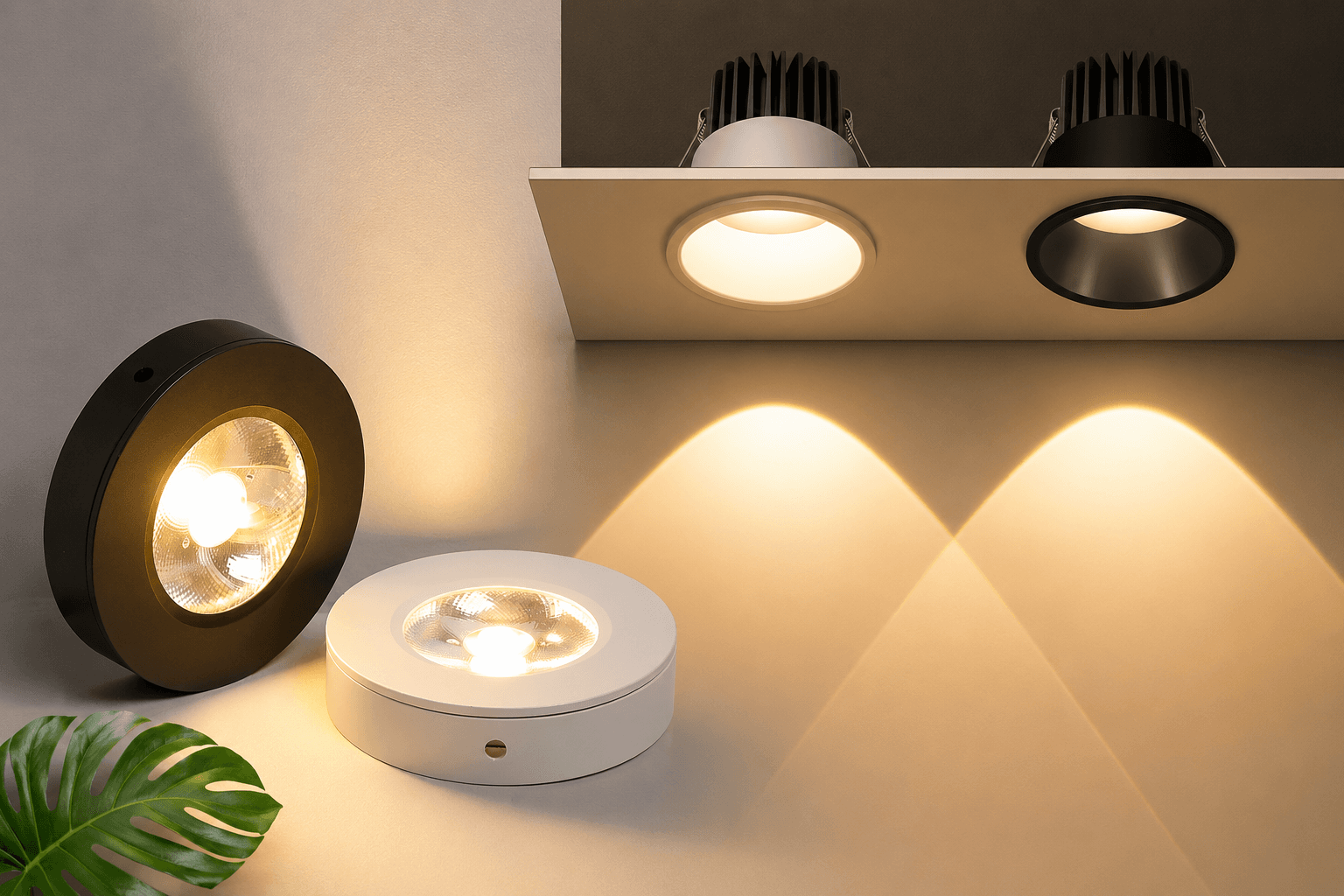
Choosing the right downlight is not simply about picking the brightest LED available. COB LED downlights are designed to provide focused, efficient and comfortable illumination, but their performance depends heavily on three factors: wattage, beam angle and CRI. Choosing the wrong combination can make a room too dim, create unwanted glare, or make colors look dull.
Whether you are lighting a bedroom, living room, office, retail store, hotel or commercial project, understanding these specifications helps you select a downlight that matches the actual requirement of the space.
At Axion Lights, we provide professional lighting solutions designed for residential, commercial and architectural applications. This guide explains what wattage, beam angle and CRI mean, how they affect lighting performance, and how to choose the right COB downlight for your project.
What Are COB LED Downlights?
COB stands for Chip on Board, a technology in which multiple LED chips are mounted closely together on a single board. Instead of seeing several individual LED points, COB technology produces a more concentrated and uniform light source.
This makes COB downlights particularly suitable when you want focused illumination with a clean ceiling appearance. They are commonly used in homes, offices, showrooms, hotels, restaurants, galleries and other spaces where controlled lighting is important.
Compared with some conventional LED fixtures, a well-designed COB downlight can provide strong light output from a relatively compact fixture while maintaining a focused beam.
However, not every COB downlight is the same. Two products with similar wattage can produce very different lighting results because of differences in optics, LED efficiency, heat management, beam angle and CRI.
How to Choose the Right Wattage
Wattage tells you approximately how much electrical power the light consumes. It does not directly tell you how bright the light will be.
For example, a high-quality 12W COB downlight may provide better usable illumination than a poorly designed 15W fixture. For this reason, you should consider lumens along with wattage whenever product specifications are available.
The required wattage depends on:
Room size
Ceiling height
Desired brightness
Number of downlights
Wall and ceiling colors
Purpose of the room
Existing natural light
Required ambience
Common COB Downlight Wattages
Wattage | Typical Use | General Lighting Character |
5W–7W | Small areas, corridors, decorative lighting | Soft to moderate |
8W–10W | Bedrooms, hallways, smaller rooms | Moderate |
12W–15W | Living rooms, offices, retail areas | Medium to strong |
18W–20W+ | Larger spaces and higher ceilings | Stronger illumination |
These are general guidelines rather than fixed rules. A 10W downlight with a narrow beam may create a strong spotlight, while a wider beam distributes its light over a larger area.
Don't Simply Choose the Highest Wattage
A common mistake is assuming that more watts always mean better lighting. Excessive wattage can increase energy consumption and may create uncomfortable brightness or glare.
Instead, think about the total lighting requirement.
For a bedroom, you may want comfortable ambient lighting rather than extremely bright illumination. A kitchen or retail store may require stronger and more evenly distributed light. A showroom displaying products may benefit from carefully positioned higher-output spotlights.
For professional projects, calculate the required illumination level and consider lumen output, room dimensions and fixture spacing instead of selecting lights based only on wattage.
What Is a Beam Angle and Why Does It Matter?
Beam angle describes how widely the light spreads from the fixture. It is one of the most important specifications when selecting COB Downlight LED products.
A narrow beam concentrates light into a smaller area, creating a spotlight effect. A wider beam spreads light over a larger area and is generally better for broad ambient illumination.
Beam Angle Guide
Beam Angle | Light Distribution | Suitable Applications |
15°–24° | Very focused | Artwork, displays, accent lighting |
25°–36° | Focused | Showrooms, feature walls, retail |
36°–60° | Medium spread | Homes, offices, hotels |
60°+ | Wide spread | General ambient lighting |
The best beam angle depends on what you are trying to illuminate.
For example, if you want to highlight a painting or decorative object, a narrow beam can draw attention to that feature. If you want general illumination throughout a bedroom, a wider beam may provide more comfortable coverage.
Narrow vs Wide Beam
A narrow beam does not necessarily mean the light is brighter. It means the available light is concentrated into a smaller area.
A wide beam covers more space but may appear less intense at a particular point.
This is why beam angle should always be considered together with wattage, lumen output, ceiling height and spacing.
For a retail showroom, for example, you might use focused LED Ceiling Lights or COB spotlights to highlight products while using wider-beam fixtures for general illumination.
What Is CRI?
CRI stands for Color Rendering Index. It measures how accurately a light source reveals colors compared with a reference light source.
CRI is particularly important in areas where the appearance of colors matters.
A higher CRI generally means that objects appear more natural and closer to their actual colors under the light.
CRI Comparison
CRI | General Color Quality | Suitable Use |
70–79 | Basic | Utility and general areas |
80–89 | Good | Homes, offices, commercial spaces |
90+ | Excellent | Retail, hospitality, art and premium interiors |
For ordinary residential applications, CRI 80 or above is commonly a practical choice. For retail stores, fashion outlets, galleries, restaurants and premium interiors, a higher CRI can be preferable.
Imagine a clothing store where a customer's shirt appears one color under the store lighting but noticeably different outdoors. Poor color rendering can contribute to this problem.
For product-focused environments, choosing a high-CRI COB downlight can therefore improve the visual presentation of merchandise.
Wattage vs Beam Angle vs CRI: What Should You Prioritize?
These three specifications solve different problems.
Wattage relates primarily to power consumption and, indirectly, potential light output.
Beam angle determines how the light is distributed.
CRI determines how accurately colors are reproduced.
You should not choose one specification independently of the others.
For example, a 15W downlight with a very narrow beam may not be appropriate for general room lighting. Similarly, a wide-beam light with excellent CRI may not provide enough illumination for a large commercial area.
The ideal combination depends on the space and its purpose.
Choosing COB Downlights for Different Spaces
Bedrooms
Bedrooms generally benefit from comfortable, non-glare lighting rather than extremely concentrated illumination. Medium or wider beam angles can provide a more relaxed appearance.
Warm or neutral color temperatures are often preferred for bedrooms, depending on the interior design.
Living Rooms
Living rooms usually need a combination of ambient and accent lighting. Medium beam COB downlights can provide general illumination, while narrower beams can highlight artwork, furniture or architectural features.
Kitchens
Kitchens require functional lighting because food preparation and other detailed tasks need good visibility. Adequate lumen output and good color rendering are particularly useful.
Offices
Offices need balanced illumination that allows people to work comfortably. Avoid creating excessive hotspots or harsh glare, particularly where people spend many hours looking at screens.
Retail Stores
Retail lighting is where beam angle and CRI become especially important. Narrower beams can highlight products, while high CRI can make colors appear more accurate.
Hotels and Restaurants
Hospitality spaces often require a combination of atmosphere and functionality. COB downlights can be used to create focused pools of light over tables, reception areas, corridors or decorative features.
How Axion Lights Can Help You Choose
Selecting lighting for a complete project can be confusing when you are comparing wattage, lumen output, color temperature, beam angle, CRI and installation requirements at the same time.
Axion Lights focuses on professional lighting solutions for residential, commercial and architectural projects. Instead of selecting a fixture based only on its wattage, consider the actual purpose of the space and the lighting effect you want to achieve.
For example, when selecting COB LED Downlights, first determine:
What area needs to be illuminated?
How high is the ceiling?
Is the light for general or accent lighting?
How much brightness is required?
Are accurate colors important?
Do you need warm, neutral or cool white?
How many fixtures will be installed?
Is glare control important?
Answering these questions makes it much easier to select the right product.
COB Downlights vs Standard LED Downlights
Feature | COB LED Downlight | Standard LED Downlight |
Light source | Multiple chips on one board | May use different LED configurations |
Light appearance | Concentrated and uniform | Depends on design |
Accent lighting | Excellent | Depends on optics |
Beam control | Often precise | Varies by fixture |
Color rendering | Available in different CRI levels | Varies by product |
Applications | Residential, commercial, architectural | General lighting |
The important point is that product quality matters more than the technology name alone. A properly engineered fixture with suitable optics and thermal management can deliver significantly better results than an inexpensive fixture with similar specifications.
Common Mistakes When Buying COB LED Downlights
One of the biggest mistakes is choosing lights based only on wattage. Always check lumen output when possible.
Another mistake is ignoring beam angle. Installing narrow-beam lights throughout a room can create bright spots and dark areas.
Choosing a low CRI fixture for a retail or display environment can also affect how products look.
You should also consider color temperature. A light can have excellent wattage, beam angle and CRI but still produce the wrong atmosphere if its color temperature does not suit the room.
Finally, don't overlook heat management. LED performance and lifespan can be affected by excessive heat, so fixture construction and installation conditions are important.
Quick Buying Checklist
Before purchasing your next LED Downlights in Pakistan, check:
Wattage: Does it provide enough output for your space?
Lumens: How much actual light does it produce?
Beam angle: Do you need focused or wide illumination?
CRI: Is accurate color reproduction important?
Color temperature: Warm, neutral or cool?
Ceiling height: Will the beam reach the required area?
Glare: Is the fixture comfortable to look at?
Heat management: Is the product designed for reliable operation?
Installation: Does it fit your ceiling cutout and electrical setup?
Application: Is it designed for residential, commercial or accent lighting?
FAQs
1. What wattage COB LED downlight is best for a room?
There is no single wattage that works for every room. Smaller spaces may require around 5W–10W fixtures, while larger rooms or commercial areas may need 12W–20W or higher. Consider room size, ceiling height, lumen output and the number of fixtures before choosing.
2. What beam angle is best for COB LED downlights?
A medium beam angle around 36°–60° is often suitable for general residential and commercial lighting. Narrower beams are better for accent and display lighting, while wider beams are useful when you want more even ambient coverage across a larger area.
3. Is CRI 90 better than CRI 80 for LED downlights?
Yes, CRI 90+ generally provides more accurate and natural-looking colors than CRI 80. CRI 80+ is suitable for many homes and offices, while CRI 90+ can be particularly beneficial for retail stores, showrooms, hospitality spaces, artwork and areas where color accuracy matters.
4. How do I choose COB downlights for my home?
Start by identifying the purpose of each room and the desired brightness. Then compare lumen output, wattage, beam angle, CRI and color temperature. For the best result, also consider ceiling height and fixture spacing rather than selecting lights based on wattage alone.
Conclusion
Choosing the right COB LED Downlights requires more than deciding how many watts you want. Wattage helps you understand power consumption, beam angle determines how the light spreads, and CRI affects how naturally colors appear.
For general home lighting, focus on comfortable brightness, suitable beam coverage and good color rendering. For offices and commercial spaces, prioritize balanced illumination and glare control. For showrooms, retail stores and display areas, beam control and high CRI can make a significant difference.
If you are planning a residential, commercial or architectural lighting project, Axion Lights can help you select lighting according to the space, application and desired visual effect rather than simply choosing the highest-wattage fixture.