Stretch Ceiling vs False Ceiling: Which Is Better for Your Islamabad Home?
By Admin | 8/12/2026
Choosing the right ceiling can completely change the look, comfort, and lighting of your home. For homeowners in Islamabad, the decision often comes down to stretch ceiling vs false ceiling. Both options can create a modern interior, hide wiring, and improve lighting, but they differ significantly in appearance, installation, maintenance, durability, and design flexibility.
If you are renovating a bedroom, living room, lounge, dining area, home theatre, or luxury interior, understanding these differences can help you avoid spending money on the wrong ceiling solution. In this guide, Axion Lights explains the practical differences between stretch ceilings and conventional false ceilings so you can choose according to your home's design, budget, lighting requirements, and long-term needs.
What Is a Stretch Ceiling?
A stretch ceiling is a modern ceiling system made from a flexible PVC or similar membrane that is stretched and fixed around the perimeter of a room using a specially designed profile. Unlike traditional ceilings, the membrane does not require extensive plastering, painting, or finishing.
One of the biggest advantages of a stretch ceiling is its ability to work with modern lighting. It can be combined with LED strips, recessed lighting, fiber optics, backlighting, and other architectural lighting solutions.
For homeowners looking for a premium appearance, a stretch ceiling in Islamabad can provide a clean and contemporary finish while also allowing creative lighting designs.
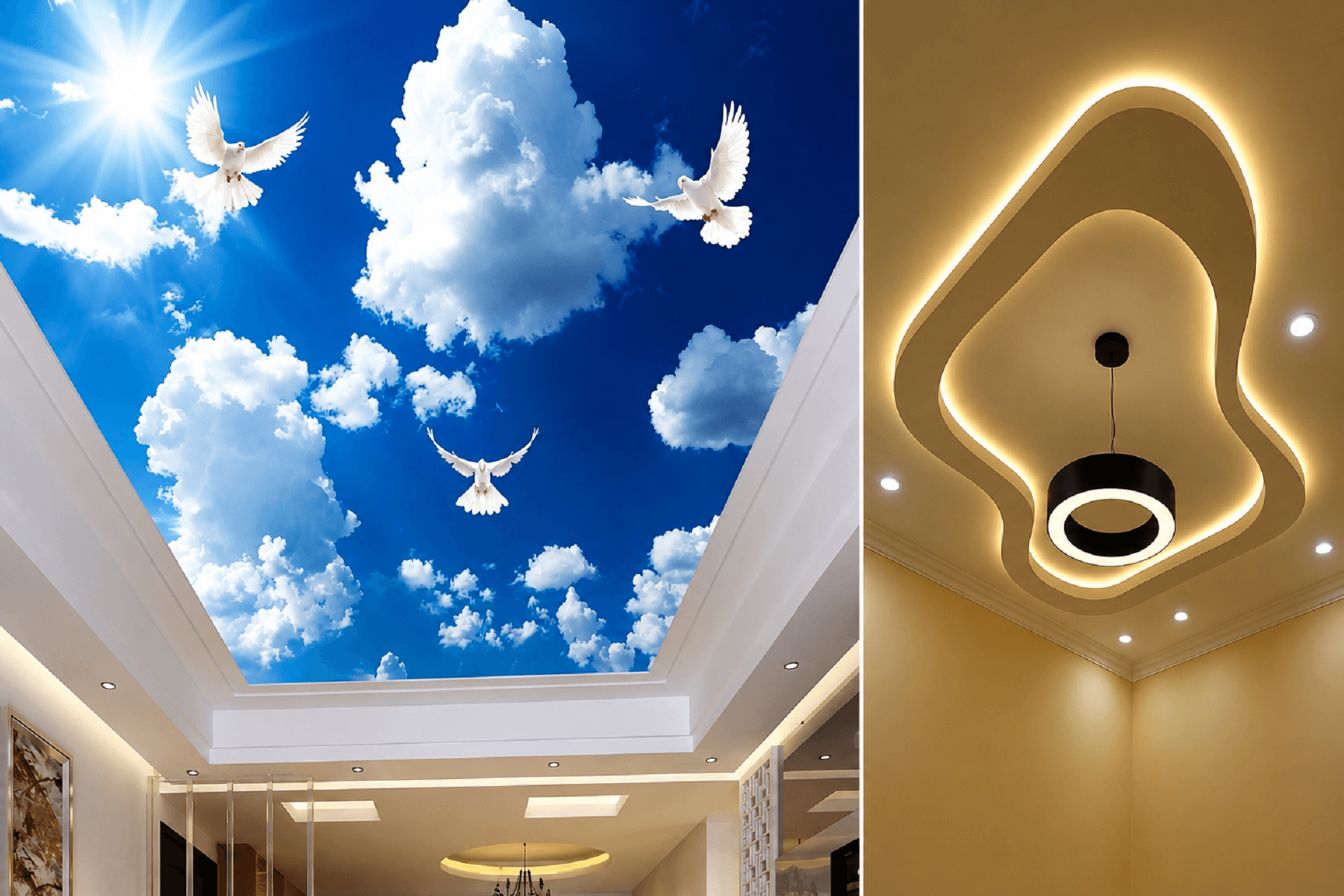
Stretch ceilings are available in different finishes, including matte, glossy, translucent, printed, and decorative options. A customized printed ceiling can even incorporate patterns, skies, artwork, or other designs.
What Is a False Ceiling?
A false ceiling is a secondary ceiling installed below the original structural ceiling. In Pakistan, gypsum board, plasterboard, POP, and similar materials are commonly used for false ceiling designs.
False ceilings are popular because they can be shaped into different levels, borders, curves, and decorative patterns. They can also conceal electrical wiring, air-conditioning ducts, pipes, and other services.
A traditional false ceiling can be a practical choice when you want a simple architectural ceiling with recessed lights or decorative elements. However, it generally requires more finishing work, such as joint treatment, sanding, painting, and periodic maintenance.
Stretch Ceiling vs False Ceiling: Key Differences
Before choosing between the two, consider what matters most for your home. The following comparison gives you a quick overview.
Feature | Stretch Ceiling | Traditional False Ceiling |
Installation | Generally faster and cleaner | Usually requires more construction work |
Surface Finish | Smooth and uniform | Depends on finishing and painting |
Painting | Usually not required | Usually required |
Design Options | Matte, glossy, translucent, printed | Shapes, levels, borders and paint finishes |
Lighting | Excellent for integrated/backlighting | Good for recessed and decorative lighting |
Maintenance | Easy to clean | May require repainting or repairs |
Moisture Resistance | Certain systems offer strong moisture resistance | Depends on the board/material used |
Dust During Installation | Relatively low | Can involve considerable dust |
Custom Printing | Available | More difficult and expensive |
Replacement/Access | Membrane can often be accessed by professionals | Repairs may require cutting or dismantling sections |
Appearance | Modern, seamless and premium | Traditional architectural appearance |
Best For | Modern, luxury and creative interiors | Conventional residential interiors |
Which Ceiling Looks Better?
This depends on your interior style.
If you prefer a minimalist, seamless, modern appearance, a stretch ceiling can be an excellent choice. The continuous surface eliminates many visible joints and can create a sophisticated architectural appearance.
For example, a living room can use a matte stretch ceiling with concealed LED lighting around the edges. A bedroom can use a soft backlit ceiling for a relaxing atmosphere, while a home theatre can incorporate a dark ceiling with fiber optic star lighting.
A false ceiling, on the other hand, is ideal if you prefer layered architectural designs. You can create geometric shapes, stepped ceilings, decorative borders, and different levels using gypsum or other materials.
The best ceiling design in Islamabad ultimately depends on the architecture and purpose of the room.
Which Is Better for LED Lighting?
Lighting is one area where stretch ceilings can offer particularly interesting possibilities.
A conventional false ceiling can accommodate downlights, spotlights, LED strips, chandeliers, and pendant lights. However, the lighting layout usually has to be planned around the physical structure of the ceiling.
Stretch ceilings can provide additional options because translucent membranes can be used for diffused illumination. LED lighting can be positioned above the membrane to create an evenly illuminated ceiling surface.
You can also combine a stretch ceiling with COB LED strip lights, recessed lighting, or fiber optic lighting for decorative applications.
For homeowners interested in architectural lighting, the ceiling should not simply be treated as a finishing material. It should be planned together with the lighting system from the beginning.
Which Is More Suitable for Islamabad Homes?
Islamabad homes often feature modern architecture, spacious living rooms, bedrooms, lounges, dining areas, and outdoor-facing spaces. The ceiling therefore needs to complement both the architecture and lighting design.
A stretch ceiling can be particularly attractive for:
Modern living rooms
Luxury bedrooms
Home theatres
Dining rooms
Reception areas
Offices
Feature ceilings
Commercial interiors
Fiber optic star ceilings
False ceilings remain useful for homeowners who want conventional gypsum designs, multiple levels, decorative borders, or a more traditional architectural appearance.
The decision should also consider the room's humidity, ventilation, existing ceiling height, lighting requirements, and overall interior design.
Stretch Ceiling vs False Ceiling: Cost Considerations
Price is naturally one of the first questions homeowners ask.
The initial cost of a stretch ceiling can be higher than a basic gypsum false ceiling because it uses specialized membrane material, profiles, and installation techniques. However, comparing only the initial price does not always give you the complete picture.
A false ceiling may involve additional expenses for framing, boards, joint finishing, putty, primer, paint, decorative work, and future repairs.
A stretch ceiling generally requires less finishing after installation because the membrane itself provides the final surface.
Cost Factor | Stretch Ceiling | False Ceiling |
Material | Specialized membrane + profiles | Boards + framing |
Painting | Usually unnecessary | Usually required |
Finishing | Minimal | Joint filling, sanding and painting |
Installation Time | Usually shorter | Usually longer |
Custom Printing | Available | Limited |
Long-Term Touch-Ups | Generally low | May require repainting |
Lighting Integration | Highly flexible | Flexible |
The final price depends on room size, material, design, lighting, installation complexity, and selected finish. For an accurate project estimate, homeowners should get a quotation based on their actual ceiling area rather than relying only on a general per-square-foot price.
Durability and Maintenance
A ceiling is a long-term investment, so durability should be considered before installation.
Stretch ceilings are designed to maintain a consistent finish without the regular painting associated with many conventional ceilings. Their smooth surface can also make routine cleaning easier.
False ceilings can also last for many years when properly installed and maintained. However, gypsum surfaces may develop cracks, stains, or damage that require repair and repainting depending on the environment and construction quality.
For either system, professional installation is important. Poor installation can reduce the performance and appearance of even a high-quality ceiling.
Which One Should You Choose?
There is no single answer for every Islamabad home. Your choice should be based on your priorities.
Choose a stretch ceiling if you want:
A seamless and premium appearance
Modern architectural lighting
Backlit or translucent ceiling effects
Customized printed designs
Easy surface cleaning
A faster and cleaner installation process
A contemporary interior
Choose a false ceiling if you want:
Traditional gypsum-style designs
Multi-level architectural shapes
Decorative borders
A conventional ceiling solution
Easy customization through plaster and paint
For homeowners who are particularly interested in lighting, combining a stretch ceiling with a professional lighting plan can create a much more distinctive result.
How Axion Lights Can Help
Axion Lights focuses on modern lighting and architectural lighting solutions that can complement residential and commercial interiors.
Instead of choosing the ceiling first and trying to fit lighting afterward, it is better to plan the ceiling and lighting together. This allows you to decide where you need recessed lights, LED strips, spotlights, fiber optics, or decorative illumination.
For example, if your goal is a modern lounge, Axion Lights can help you explore options such as LED ceiling lights, COB LED lighting, and architectural lighting that work with your selected ceiling design.
For a luxury home theatre, a stretch ceiling can also be combined with fiber optic lighting to create a starry ceiling effect.
The right combination of ceiling material and lighting can make a significant difference to the atmosphere of a room.
Frequently Asked Questions
1. Is a stretch ceiling better than a false ceiling?
A stretch ceiling can be better if your priority is a seamless finish, modern appearance, integrated lighting, easy maintenance, and creative designs. A false ceiling may be better if you prefer traditional gypsum designs and multi-level architectural shapes.
2. Is a stretch ceiling expensive in Islamabad?
The price depends on the membrane type, ceiling size, finish, design, lighting, and installation requirements. Although the initial price can be higher than a basic false ceiling, there may be fewer finishing and repainting requirements after installation.
3. Can LED lights be installed in a stretch ceiling?
Yes. Stretch ceilings can be designed around different lighting systems, including LED strips, recessed lighting, backlighting, and fiber optic effects. Lighting should be planned before installation so the required fixtures and electrical components can be positioned correctly.
4. How long does a stretch ceiling installation take?
Installation time depends on the room size, ceiling design, number of lighting fixtures, and complexity of the project. Compared with conventional ceiling construction, stretch ceiling installation can generally be completed with less on-site finishing and disruption.
5. Can stretch ceilings be customized?
Yes. Stretch ceilings can be available in different colors, finishes, textures, and designs. Printed stretch ceiling fabric can also be used when homeowners want a customized visual design rather than a plain ceiling.
6. Which ceiling is easier to maintain?
Stretch ceilings are generally easy to maintain because the finished membrane provides a smooth surface that does not normally require regular painting. False ceilings may need occasional touch-ups or repairs if the surface develops cracks, stains, or other damage.
7. Can a stretch ceiling be used in a home theatre?
Yes. Stretch ceilings can be particularly effective in home theatres because they can accommodate creative lighting designs. A dark finish combined with fiber optic star lights or controlled LED illumination can create an immersive atmosphere.
8. Should I choose a stretch ceiling or false ceiling for my bedroom?
For a modern bedroom, a stretch ceiling can provide a clean appearance and soft indirect lighting. A false ceiling is a good alternative if you want decorative borders, stepped designs, or conventional recessed lighting. Your choice should match the room's design and lighting goals.
Conclusion
When comparing stretch ceiling vs false ceiling, both have their own advantages. A traditional false ceiling remains a practical option for conventional gypsum designs, while a stretch ceiling offers a more modern approach with seamless finishes, customized designs, and exciting lighting possibilities.
For an Islamabad homeowner, the right choice should not be based on appearance alone. Consider your budget, room height, maintenance expectations, desired lighting effects, interior style, and long-term requirements.
If your goal is a clean, contemporary interior with integrated architectural lighting, a stretch ceiling in Islamabad can be an excellent option. With the right combination of ceiling material and lighting products, Axion Lights can help you create a space that looks modern while meeting your practical lighting needs.